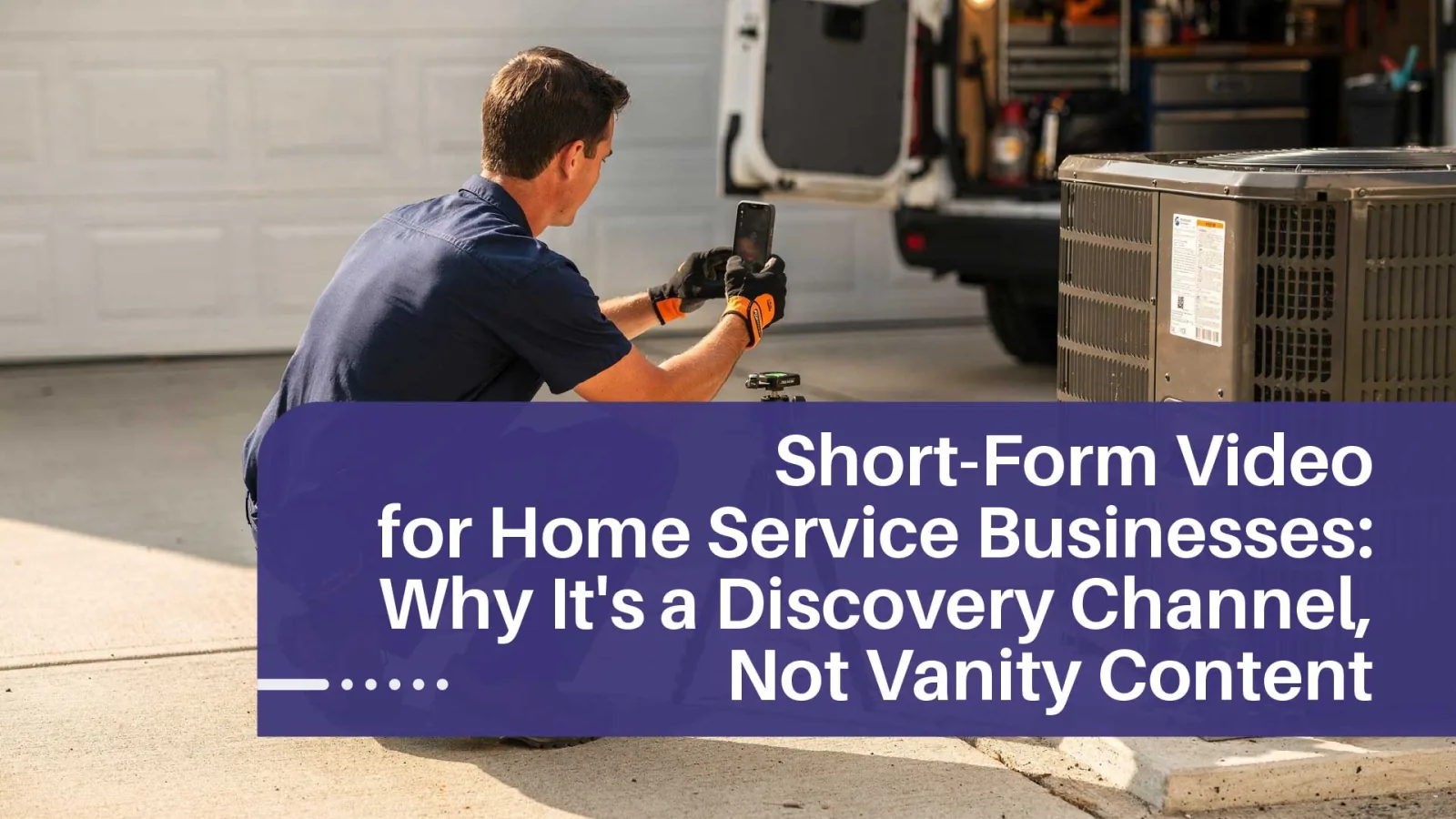
Most home service owners have quietly filed short-form video under "stuff for influencers." The crew is booked solid, the phone is ringing, and nobody has time to choreograph a dance on a roof. That instinct makes sense. It is also costing you leads.
Short-form video for home service businesses is not vanity content. It is a discovery channel that runs alongside Google, and your future customers are already there. The home services businesses that treat Reels, YouTube Shorts, and TikTok as a search-and-discovery play are showing up where homeowners now look, often before those homeowners ever type a company name into a search bar.
This post covers what to actually film on the jobsite, how long clips should run, how often a busy shop can post without wrecking the schedule, how a single shoot can feed every platform you care about, and how the right captions and setup help those clips get found in search. No influencer routine required.
Why Short-Form Video for Home Service Businesses Is a Discovery Channel
Short-form video is a discovery channel because homeowners increasingly find and vet local companies on YouTube, Instagram, and TikTok before they run a formal search. It does not replace Google. It adds a surface where you can show up, build trust, and get remembered for the day the water heater quits.
The audience is not niche. Pew Research Center found that 84% of U.S. adults use YouTube, half use Instagram, and 37% use TikTok, with roughly half of adults under 30 opening TikTok daily (Pew Research Center). Those are your homeowners, your commercial decision-makers, and the adult children helping parents pick a contractor.
Here is the part that keeps this honest. This is not the tired "Gen Z is abandoning Google" story. In a survey by Adobe Express, 49% of consumers said they had used TikTok as a search engine, up from 41% in 2024, yet the share of Gen Z who said they would rather use TikTok than Google actually fell from 8% to 4% over the same stretch. Video is an added way to be found, not a Google replacement, and it works best stacked on top of the local SEO fundamentals you already have in place. Treat it that way and the strategy gets a lot simpler.
Where Customers Actually Find Home Service Businesses on Video
Customers find home service companies through three main video surfaces: YouTube (including how it now feeds Google's AI results), TikTok search and its local features, and Instagram Reels. Each one is a place a homeowner can meet you before they ever visit your website.
YouTube is the one most owners underrate for local SEO. A Moz analysis of nearly 40,000 queries highlights that YouTube is the second most cited external source in Google's AI Mode, and that 88% of AI Mode citations do not appear in the organic top-10 results for that exact query. In plain terms, a helpful YouTube Short can get you quoted in an AI answer even when your website does not rank on page one.
TikTok has become a genuine search tool for local services, not just entertainment. TikTok reported that searches for "small business" jumped 479% during the first quarter of 2026, and that 89% of small and medium businesses said their sales increased after promoting on the platform (TikTok Newsroom). BrightLocal's ongoing research shows a similar shift for local discovery: beyond the traditional review sites, Instagram is now wrestling with YouTube for the No. 2 spot among the platforms consumers turn to for local business reviews (BrightLocal). YouTube Shorts local SEO and TikTok for home services are no longer fringe bets. Treat each platform as one channel in a broader social media strategy, not a stand-alone experiment.
What Home Service Companies Should Film
The best home service videos are simple: before-and-after transformations, quick fixes homeowners can relate to, short team introductions, and answers to the questions your customers ask most. You do not need a script or a studio. You need a phone and a real moment on the job. These are the same content marketing basics that work in a blog post or an email, just filmed instead of written.
The strongest content idea comes straight from your front office. Roger Wakefield, owner of Texas Green Plumbing, told PHCPPROS, "Ask your CSRs, 'What question have you been asked most often this week?' That's a video right there. If your company can be the company that can answer that question, you are bound to get business." Your customer service reps hear the same five questions every week. Each one is a Reel for contractors that answers real search intent.
Do not let gear be the excuse. Describing how he got started making videos, Wakefield noted, "We had iPhones and iPads, and those were our cameras." A clean before-and-after of a panel upgrade or a re-piped bathroom, shot on the phone already in your tech's pocket, will outperform another "Spring Tune-Up Special" text post every time.
How Long Videos Should Be and How Often to Post
Aim for clips around 60 seconds and start with roughly one video a month. That length is long enough to tell a story and short enough to hold attention, and a monthly cadence is realistic for a shop that runs on billable hours. There is no magic number the platforms require, so consistency beats volume.
On length, Corey Halstead, co-owner of HALSTEAD Media, told the National Association of Landscape Professionals, "The real workhorse of video is the 60-sec video. It can be used in ads, can be chopped up into micro-clips, and is long enough to tell a story in a newsfeed." One 60-second clip becomes the source material for several shorter ones.
The first two seconds decide everything. Katy Doss, founder and CEO of Script Marketing, also told NALP, "You have to grab people in the first two seconds. You also have to make sure that every video has closed captioning, since most people watch without sound." Lead with the result, not the intro. On cadence, Doss keeps it simple: "Aim for one video a month to start. Once you see the results, you'll want to do more." Start small and stay consistent. Do not wait for perfect.
How One Jobsite Shoot Feeds Every Platform
One good jobsite shoot can produce content for every platform at once. Film the full job in a few clips, then cut it into a YouTube Short, an Instagram Reel, a TikTok, a Google Business Profile video, and a clip for a website built to convert. Same footage, different edits.
That reuse is the whole efficiency argument. Halstead's point about the 60-second video being "chopped up into micro-clips" is exactly how a busy shop keeps up without a full-time creator. Match the edit to the platform instead of dropping identical files everywhere, since each audience watches a little differently.
The local SEO payoff comes when that video feeds your owned properties, not just a social feed. According to Google Business Profile Help, a Business Profile video must be up to 30 seconds long, up to 75MB, and 720p resolution or higher, so plan a short vertical cut that fits those specs. Pair that clip with the rest of your Google Business Profile optimization, and the profile does more of the selling on its own.
That same footage strengthens your service pages and gives your website something homeowners actually watch. Social video marketing for home services works best when the clips point back to a site you control, which is one more reason a fast, well-structured platform like Joomla beats a plugin-heavy setup you have to babysit.
How Short-Form Video Helps You Get Found in Search
Short-form video earns the "SEO" label in three ways. It feeds Google through YouTube. It gives search engines text to read. And it drives the branded searches that lift everything else. None of it needs a marketing degree, just a few habits on every clip.
Start with what a search engine can read. A video is pixels. The caption and description are the words Google, YouTube, and TikTok actually index. So caption every clip, and write the description the way a homeowner talks: "why is my AC freezing up," not "evaporator coil airflow restriction." Captions pull double duty. They keep the video clear with the sound off, and they connect your clip to a real search.
Next, help Google show the video off. Put a clip on a page you own and add video structured data. That markup can earn a video thumbnail right in the results, sometimes with clickable key moments, instead of a plain blue link. A result with a real face and a finished job wins the click. Title each video around one phrase a homeowner would search: the service plus the city.
Then point that attention at property you own. A Short or Reel is discovery. Your website and Google Business Profile are where it converts, so embed the clip on the matching service page. And measure the right thing: not view counts, but branded searches and referral traffic. When someone watches a clip today and looks up your name next week, that is the payoff compounding.
What This Looks Like for a Regional Home Service Company
Picture a 40-technician regional company with a marketing manager already on staff, competing against national chains for the same homeowners. The owner does not need to go viral. She needs a repeatable system that produces trust signals every month across search, social, and the map pack.
Here is a realistic version. Once a month, the marketing coordinator rides along on two or three interesting jobs and captures raw footage on a phone: a rooftop before-and-after, a technician explaining one common question, a quick fix that makes a homeowner's day. That single afternoon becomes four or five short clips, edited to fit YouTube Shorts, a Reel, a TikTok, and a 30-second Google Business Profile video. The question-of-the-week clips double as answers embedded on service pages.
The honest outcome is not overnight leads. It is compounding visibility: more branded searches, more "I saw your video" mentions on sales calls, and a Business Profile that looks alive instead of abandoned. This is also the point where a home service company usually decides whether to keep video in-house or bring in help. A marketing manager can shoot and post, but sustaining a monthly cadence, matching edits to each platform, and tying it all back to local search is where an agency partner earns its keep. In a survey by Service Direct, 59% of homeowners said they are more likely to hire a contractor whose website has videos, so the work compounds on the site, too.
Conclusion: Start Small, Stay Consistent, and Keep It On the Jobsite
Short-form video is not a popularity contest for a home service company. It is a discovery channel that puts you in front of homeowners on YouTube, TikTok, and Instagram, feeds Google's AI results, and makes your Google Business Profile and website more convincing. The recipe is simple: film real jobs on a phone, keep clips around 60 seconds with the payoff up front, post about once a month, and reuse every shoot across platforms.
You do not need to be an influencer. You need to be the company that answers the question every homeowner is already asking. If you want a second set of eyes on whether short-form video fits your marketing plan, or whether it makes more sense to build it in-house or hand it off, schedule a conversation. No pressure, no pitch, just honest feedback.
Frequently Asked Questions
Do Home Service Companies Need to Be on TikTok, or Is YouTube Enough?
Start with the platform your customers already use, which is usually YouTube for home services, then expand. YouTube feeds Google's search and AI results, so a Short can help you get found even when your website does not rank on page one. Add TikTok and Instagram once your monthly filming habit is steady.
What Equipment Do We Need to Start Filming Short-Form Video?
A modern smartphone is enough to start. Many successful trade channels began by filming jobs on the phone already in the tech's pocket, then added a clip-on microphone and a small tripod once the habit stuck. Good light and clear audio matter far more than an expensive camera.
Will Short-Form Video Actually Help Our Google Ranking?
Video helps indirectly, and increasingly directly. It strengthens your Google Business Profile, gives your service pages engaging content, and earns branded searches when homeowners look you up after watching. YouTube is also the second most cited external source in Google's AI Mode, so a helpful clip can surface in AI answers about local services in your area. On pages you own, accurate captions give search engines text to index, and video structured data can earn your result a thumbnail instead of a plain link.
Should We Hire an Agency or Keep Video In-House?
Small shops can start in-house with a phone and a monthly filming routine. Larger companies often bring in help once video needs to run on a consistent cadence, get edited for each platform, and tie back to local search and website content. The deciding factor is usually whether your team can sustain the work every month without it slipping.