If your pest control website's traffic is down, you are not imagining it. You are not behind on something everyone else figured out. You are sitting inside an industry-wide decline that started in 2024, and most of the field is still in denial about it. Our 2026 audit looked at 300 pest control companies across the country, and the pattern is the same almost everywhere: organic traffic is down, map pack visibility is shaky, and most of the marketing playbook that worked between 2018 and 2023 stopped working at roughly the same moment.
This post walks through what changed, what the audit found, and how to figure out which of the four most common problems is hitting your site right now. If you run a 6 to 20-technician shop and you have been wondering why the phone is quieter even though your service quality is the same, this is for you. We work with pest control business owners every day who are seeing the exact same numbers, and the diagnosis is almost never what owners think it is.

Written By: Chad J. Treadway | June 23, 2026
Chad is a Partner and our Chief Smarketing Officer. He will help you survey your small business needs, educating you on your options before suggesting any solution. Chad is passionate about rural marketing in the United States and North Carolina. He also has several certifications through HubSpot to better assist you with your internet and inbound marketing.
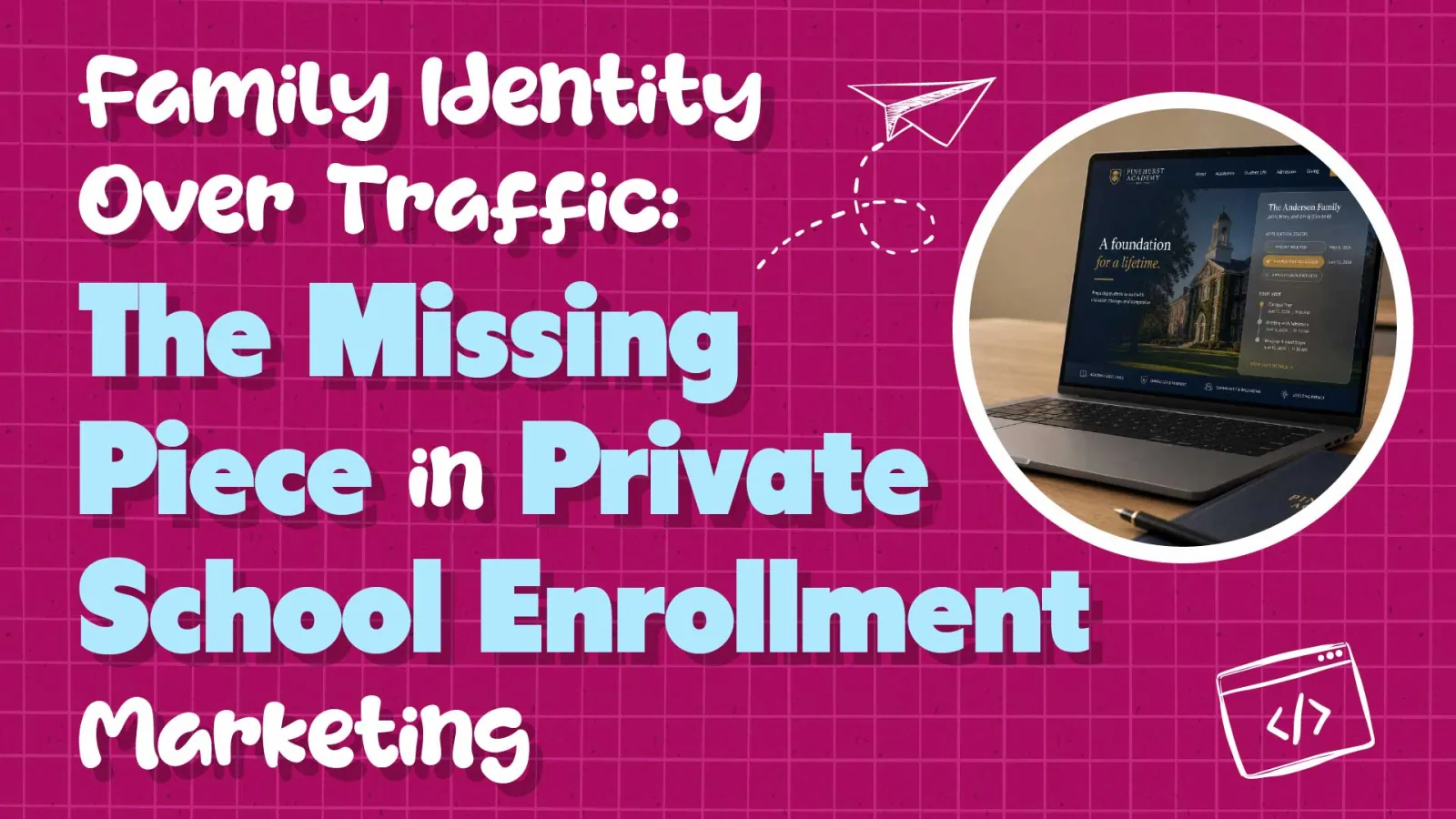
Most school marketing spends money to drive more traffic. More clicks, more visitors, more impressions. But here's the uncomfortable truth: traffic alone doesn't fill seats. If you can't see who is behind those visits or what they're actually researching on your site, you're leaving enrollment on the table.
An identity-first approach changes that equation. Instead of counting anonymous visitors, you identify families at the household level, enrich that data with demographic context, and track what they're actually researching across multiple visits. That's when your website stops being a traffic report and becomes an enrollment intelligence tool. We help private schools implement this exact system to turn traffic into qualified families ready to apply.
This isn't a replacement for your existing admissions system. It's a smarter way to power it. And it works because every meaningful interaction (pricing page, program details, financial aid information) becomes a signal you can act on immediately.

Written By: Adam Bennett | June 23, 2026
Adam is the president and founder of Cube Creative Design and specializes in private school marketing. Since starting the business in 2005, he has created individual relationships with clients in Western North Carolina and across the United States. He places great value on the needs, expectations, and goals of the client.
July 1 is halftime. The phones have been ringing since the first termite swarm in April, mosquito season is at its peak, and your route board is full enough that it feels like you can finally exhale. Don't. The operators who own the fall didn't start prepping in October. They started building their rodent pipeline in August, and by the time the first homeowner Googled "what's scratching in my walls," their page was already indexed, their reviews were already stacked, and their commercial accounts were already booked through January.
This guide is for independent pest control companies running 5 to 25 technicians who are sitting down for a quarterly review and asking the right question: what do we do for the next 90 days? It's a Q3 planning playbook with budget pacing, regional pest priorities, content timing, review acquisition, commercial moves, and the operational shifts that turn summer momentum into year-round revenue. The independent operator who treats July 1 like halftime, not the fourth quarter, walks into October with a plan instead of panic.
Written By: Chad J. Treadway | June 22, 2026
Chad is a Partner and our Chief Smarketing Officer. He will help you survey your small business needs, educating you on your options before suggesting any solution. Chad is passionate about rural marketing in the United States and North Carolina. He also has several certifications through HubSpot to better assist you with your internet and inbound marketing.
Most school marketing teams are measuring the wrong thing, and the Head of School's quarterly budget review is the moment that mistake finally catches up with them. Click-through rates, social impressions, and form submissions get printed out, tabbed in a folder, and walked into the conference room as proof that the marketing dollars are working. The math has a hole in it big enough to drive an admissions bus through.
Roughly 95 to 97 percent of the families who land on the school's website never fill out anything. They read the tuition page. They scroll through the financial aid FAQ. They open three program pages, compare schedules, and leave. No form, no name, no follow-up, no credit assigned to the channel that brought them in. For private school marketing teams trying to prove ROI to a CFO who already thinks the budget is too big, that missing 95 percent is not a rounding error. It is the entire conversation.
Family identification technology closes that gap, and when it is paired with a serious school marketing attribution framework, it turns a fuzzy "we got a lot of traffic this quarter" report into a defensible ROI story. The rest of this post walks through seven concrete ways that pairing changes what admissions and marketing directors can prove, in a language a board actually understands.
Written By: Adam Bennett | June 22, 2026
Adam is the president and founder of Cube Creative Design and specializes in private school marketing. Since starting the business in 2005, he has created individual relationships with clients in Western North Carolina and across the United States. He places great value on the needs, expectations, and goals of the client.