For pest control marketing budget guidance, Scorpion's 2026 State of Pest Control Marketing Report puts forward 5% of revenue as the recommended target. That number sits below the U.S. Small Business Administration's published guidance, below the Gartner all-industry average, below the Duke/Deloitte CMO Survey overall figure, and below the pest-control-specific average from the 2025 NPMA/PCO Bookkeepers industry study. The honest reading is that 5% is the floor, not the target. This piece shows what a pest control marketing budget at 5%, 7.5%, and 10% actually buys at $1.8 million and $4 million in revenue, where the spend goes by channel, and what the lead economics say about the gap between defending share and gaining it. We work with pest control companies on this exact question every quarter, and the answers tend to surprise the people asking them.
What Do Independent Marketing Budget Benchmarks Say About Pest Control?
Independent benchmarks place marketing spend higher than 5%. The U.S. Small Business Administration cites industry data showing marketing spend averages 7.9% of revenues. The Duke/Deloitte CMO Survey 2025 averages 9.4% overall. The 2025 NPMA/PCO Bookkeepers industry study lands the pest control industry average at 6.6%.
The 5% figure from Scorpion's 2026 State of Pest Control Marketing Report is the lowest of every published benchmark on the table. It is not close to the lowest number. It is the lowest number.
The U.S. Small Business Administration cites industry data showing that marketing spend averages 7.9% of revenues, with B2C service companies — the model closest to pest control's recurring-contract structure — averaging 11.8%. That framework applies broadly across small business categories.
The Gartner 2025 CMO Spend Survey reported that all-industry marketing budgets averaged 7.7% of company revenue, with 59% of surveyed CMOs characterizing that figure as insufficient to execute their strategic initiatives.
The CMO Survey 2025 from Duke University's Fuqua School of Business and Deloitte Digital reported that marketing budgets now represent 9.4% of company revenues in 2025, up from 7.7% in 2024.
For pest-control-specific data, the 2025 NPMA/PCO Bookkeepers Pest Control Industry Cost Study puts the pest control industry average at 6.6% of revenue.
Stack the numbers. SBA data shows 7.9% overall average. Gartner at 7.7%. Duke/Deloitte CMO Survey at 9.4% overall. NPMA at 6.6% pest control industry average. The 5% figure lives below all of them. That does not make 5% wrong on its face. It makes 5% a number that requires more justification than the prevailing benchmark, not less.
What Does a 5% Pest Control Marketing Budget Buy at $1.8 Million in Revenue?
A 5% budget at $1.8 million is $90,000 a year, or $7,500 a month. After agency or platform fees, the working media budget is roughly $3,500 a month. That funds local search, basic Google Business Profile management, and minimum viable Google Ads. It does not fund net-new growth.
At the $1.8 million revenue level, the first place that $7,500 goes is overhead. If the pest control company is on a proprietary all-in-one marketing platform or with a full-service agency, $3,000 to $5,000 of the monthly budget is typically consumed by management fees, software access, or proprietary platform costs before any media is purchased. That leaves roughly $3,500 a month to spend on actual lead generation.
Pest control search advertising is competitive. Based on findings from WebFX 2026 Home Services Marketing Benchmarks, pest control B2C cost-per-lead runs $30 to $98, depending on market and channel. At the mid-range CPL of roughly $64 per lead, $3,500 a month produces roughly 54 leads. At a 40% close rate (a realistic benchmark for broad local search leads, per industry conversion data), that is about 21 new customers a month.
Twenty-one new customers a month at a $1.8 million pest control company replace churn. It does not expand the route board. That is the entire point of the math.
What the 5% tier does not fund:
- Dedicated content production at the pace search engines reward
- Retargeting at a meaningful frequency
- Video production for organic and paid social
- Speed-to-lead infrastructure that improves conversion on the leads already paid for
- CRM-integrated automation that converts dormant residential customers into recurring contracts
- Reputation management beyond manual review responses
A pest control marketing budget at 5% of revenue is a maintenance budget. It works when the company has high organic traffic, a strong word-of-mouth pipeline, and no geographic expansion plans. The instant any of those three conditions falls away, 5% becomes a slow leak.
What Does a $4 Million Pest Control Company Get From a 5% Budget?
A 5% budget at $4 million is $200,000 a year, or $16,666 a month. The number sounds substantial. At an established 30-truck operation defending its existing market against national chains, the entire amount is consumed by defensive search and local SEO, with nothing left for route densification or new territory.
At $4 million in revenue, $16,666 a month is real money. It is also the budget for an operation with roughly 25 to 30 trucks, several specialty service lines, and direct competition from at least one national chain in the same metro.
Where the money goes:
- $7,000 to $9,000 a month on Google Ads to keep "exterminator near me" intent locked up across the primary service area
- $2,000 to $3,000 on Google Local Services Ads, where pest control cost-per-lead typically runs in the lower double-digits to mid-double-digits per qualified lead in most markets
- $1,500 to $2,500 on local SEO, Google Business Profile management, and review generation
- $1,500 to $2,000 on website maintenance, hosting, and conversion-tracking infrastructure
- $1,500 to $3,000 on agency or marketing manager oversight
Add it up, and the entire pest control marketing spend is on defense. Nothing remains for route densification ads in existing service areas. Nothing remains for entering an adjacent metro. Nothing remains for the brand campaign that competes with a national chain on something other than auction price.
A pest control company at $4 million typically experiences 15% to 20% annual customer attrition between non-renewals, moves, and one-time emergency customers who never enter the recurring program. Fieldwork's pest control profitability guide documents 15% to 20% annual churn as the standard planning assumption for residential accounts, with commercial accounts running lower at 5% to 10%. At a 15% attrition rate, that is roughly 1,500 customers a year that have to be replaced before the company adds a single net-new customer to the book. The customer-acquisition spend required to replace 1,500 customers absorbs nearly all of a 5% budget by itself.
This is the defensive trap. The number looks adequate on a board slide and is fully consumed by the math of standing still.
What Does a 7.5% to 10% Pest Control Marketing Budget Fund?
At 7.5%, an established pest control company gains room for content production, retargeting, and conversion-rate work. At 10%, the budget supports CRM automation, speed-to-lead infrastructure, and densification campaigns that compound returns. The jump from 5% to 10% is roughly the difference between holding ground and gaining it.
At $4 million in revenue, the math changes meaningfully at each step up the percentage scale.
7.5% of revenue is $300,000 a year, or $25,000 a month. The additional $8,300-plus a month over the 5% scenario funds the work that the defensive budget cuts first. A sustained content program targeting commercial buyer searches. Retargeting that captures the majority of website visitors who do not convert on their first visit. Conversion-rate work that improves the yield on every other channel in the mix.
10% of revenue is $400,000 a year, or $33,333 a month. At that level, the pest control marketing spend supports the technology investment that becomes the moat: CRM-integrated automation, lead-routing systems, and speed-to-lead infrastructure that responds within five minutes.
The difference matters. Speed-to-lead performance is a documented differentiator in home services conversion. Research compiled by Convoso found that leads contacted within five minutes are 21 times more likely to convert than leads contacted after 30 minutes, and 78% of customers buy from the first company to respond. The pest control company that responds in five minutes books the customer; the company that responds in an hour cannot.
For an established 30-technician operation, a 10% pest control marketing budget also funds geographic densification work that compounds. Densification ads target the streets adjacent to existing routes. Each new customer added to a high-density route increases gross margin per truck-hour. That margin lifts funds for future marketing without raising the percentage. Compounding returns are the actual prize.
How Do Lead Economics Justify a Higher Pest Control Marketing Budget?
Pest control has favorable unit economics relative to other home services. Average cost-per-lead runs lower than HVAC, plumbing, or roofing in most markets. When a recurring residential contract delivers multi-year value at a low single-digit acquisition cost percentage, the case for investing above 5% writes itself.
The case for a higher pest control marketing budget is not "spend more because the benchmarks say so." The case is the lead economics, which favors pest control more than most adjacent trades.
Pest control B2C cost-per-lead runs $30 to $98, depending on market and channel, per evidence from WebFX, with Local Services Ads typically tracking lower than search.
Compare those numbers to other home services categories. WebFX's home services dataset documents HVAC cost-per-lead averaging well above $100 in competitive markets, with roofing exceeding $200 in some metros. Pest control sits at the lower end of the home services CPL distribution.
A residential recurring pest control contract typically runs $400 to $700 a year. Fieldwork reports residential monthly service contracts ranging from $35 to $75 per month, and consumer pricing data from Housecall Pro shows recurring monthly or quarterly plans running $40 to $80 per visit in 2026. At a three-year average retention, the lifetime contract value falls in the $1,200 to $2,100 range. At an average customer acquisition cost of $100, the customer-lifetime-value-to-customer-acquisition-cost ratio sits between 12-to-1 and 20-to-1. That is elite economics for any service business.
The implication for budget setting is direct. When every customer acquired at $100 returns more than $1,000 in lifetime contract value, the marginal customer above the 5% spend tier is profitable. The constraint is operational capacity, not marketing math.
This is the argument an established pest control CEO walks into a CFO meeting with. Not "the benchmarks say 7.7%." That is a weak frame. The strong frame is "every customer my marketing buys returns 12 to 20 times their acquisition cost, and we are leaving 30% of acquisition headroom on the table."
When Is 5% of Revenue Actually Enough for Pest Control Marketing?
5% works when the pest control company already has high organic traffic, a strong word-of-mouth pipeline, no geographic expansion plans, and a stable competitive set. Lose any one of those four conditions, and 5% stops being a maintenance budget and becomes an erosion budget.
5% is defensible. It is not always wrong. The pest control company at $4 million with strong reviews, a well-developed organic search position in its primary metro, no geographic expansion goals, and no national chain making aggressive moves into the territory can run on 5% indefinitely.
The test is simple. Take the current pest control marketing spend and ask one question: can the budget fund any new channel experiment, or is every dollar already committed to defending an existing position? If the answer is the second one, the company is a new competitor entering the market, away from a problem.
The math of marketing under-investment takes a few quarters to show up in lagged revenue effects. Then it shows up all at once.
Sizing a Pest Control Marketing Budget for 2026
The right pest control marketing budget for an established operation in 2026 sits between 7% and 10% of revenue. That range is consistent with the SBA's documented industry average of 7.9%, the pest-control-specific 6.6% from the NPMA study, and the lead economics that pest control delivers in the home services category. 5% can hold ground in the right conditions. It cannot win the metro.
The harder question is what they spend funds inside that range, and where each dollar contributes to acquisition versus retention versus brand. That is the conversation worth having before the next budget cycle.
If you want a second set of eyes on your current pest control marketing budget, schedule a conversation. I will tell you whether your number is defensive or offensive, and where the next dollar should go.
Frequently Asked Questions
What is the recommended marketing budget for a pest control company?
Most independent benchmarks place the recommended pest control marketing budget between 6% and 10% of revenue. The U.S. Small Business Administration cites data showing the small business average at 7.9% of revenues. The 2025 NPMA/PCO Bookkeepers industry study reports 6.6% as the pest control industry average.
Is 5% of revenue enough for pest control marketing?
A 5% pest control marketing budget can be enough when the company has high organic traffic, a strong word-of-mouth pipeline, no geographic expansion plans, and a stable competitive set. In any other condition, 5% functions as a maintenance budget that replaces customer churn without adding new growth capacity. The 5% figure sits in every published independent benchmark below, so the burden of proof falls on the operator who chooses it.
How does pest control marketing spend compare to other industries?
Pest control marketing spend at the industry average of 6.6% sits below the all-industry Gartner figure of 7.7% and well below the Duke/Deloitte overall figure of 9.4%. The category has favorable unit economics. Cost-per-lead runs lower than HVAC, plumbing, or roofing in most markets, and the lifetime contract value of recurring residential agreements is high relative to acquisition cost. Operators who want to model their own ratio can run the numbers through Cube Creative's pest control marketing ROI calculator before the next budget cycle.
What channels can I realistically fund at different pest control marketing budget tiers?
At 5% of revenue, expect to fund local search, Google Business Profile management, baseline Google Ads, and minimum Local Services Ads spend. At 7.5%, add sustained content production, retargeting, and conversion-rate work that lifts every other channel. At 10% and above, fund CRM automation, speed-to-lead infrastructure, video production, and route densification campaigns that compound returns over time. The channel mix changes with the percentage; the inflection point sits between 7.5% and 10%.

Written By: Adam Bennett | May 07, 2026
Adam is the president and founder of Cube Creative Design and specializes in private school marketing. Since starting the business in 2005, he has created individual relationships with clients in Western North Carolina and across the United States. He places great value on the needs, expectations, and goals of the client.
Your 500 Google reviews look great. They look slightly less great when a homeowner pulls up your Yelp profile, sees a 2.8, scrolls down to your Facebook page, where the most recent review is from 2023, and quietly calls the competitor with 80 reviews and a consistent footprint everywhere they checked.
That homeowner is not unusual. Scorpion's 2026 State of Pest Control Marketing Report names this multi-platform behavior (homeowners cross-checking three or more pest control review sites before they pick up the phone) as the dominant buying pattern in the home services category. Independent verification from BrightLocal confirms it: in the Local Consumer Review Survey 2026, the average consumer uses six different review sites when evaluating which local business to trust.
For pest control companies at the 31-to-50-employee level, this is the difference between dominating a market and watching a competitor with half the reviews and twice the discipline poach termite jobs and recurring residential routes. The Google-only review strategy that worked in 2020 is now actively costing you commercial accounts, route density, and the kind of branded search dominance that should be table stakes at your size.
This post is a rank-ordered map of where pest control reviews need to live in 2026, written for the operator who already has a marketing manager, an FSM platform, and several hundred Google reviews. The question is not whether reviews matter. The question is which platforms justify active management, which justify passive maintenance, and which earn a polite "no, thank you" no matter how aggressive their sales rep gets.
Why Do Homeowners Check Multiple Pest Control Review Sites in 2026?
Homeowners cross-check review sites because the stakes of inviting a pest control technician into the house, often around children, pets, and food, are too high to trust a single source. Modern consumers verify a contractor across three to six separate platforms before they pick up the phone or submit a form, and the trust threshold for pest control runs higher than it does for a roof inspection or a plumbing call.
The data behind the behavior is steep. Research by BrightLocal shows that 47% of consumers will not engage with a business that has fewer than 20 reviews, 68% require an aggregate rating of at least 4.0 stars, 31% will only consider businesses rated 4.5 stars or higher, and 74% prioritize reviews written in the last three months, dismissing older feedback as stale.
Artificial intelligence has accelerated the trend rather than simplified it. Findings from BrightLocal show that 45% of consumers now use AI tools such as ChatGPT, Gemini, and Google AI Overviews for local business recommendations, and those tools synthesize reviews across multiple directories rather than pulling from Google alone. A pest control company that lives only inside Google's ecosystem becomes harder to surface in AI-generated answers, regardless of how many five-star reviews sit on the GBP profile.
How Do Online Reviews Affect Local Search Rankings for Pest Control Companies?
Online reviews are one of the strongest non-proximity ranking factors in Google's local pack algorithm. Moz's 2026 Local Search Ranking Factors analysis, compiled by Searchlab, estimates review signals account for roughly 15% of the weight Google uses to rank pest control companies in the map pack, alongside review velocity, keyword content, and third-party authority signals.
The local pack matters because it is where the clicks are. As reported by Searchlab, the local pack captures 42% of all search clicks for local-intent queries, and businesses inside it receive 126% more traffic than the standard organic links beneath the map. Data compiled by Searchlab further confirms that businesses maintaining an aggregate rating of 4.0 or higher appear 58% more often in the local pack than competitors with lower ratings.
Reviews also do quite keyword work. When customers describe specific services in their reviews ("they handled our termite inspection," "the heat treatment for bed bugs worked"), Google indexes those phrases as additional context. Research published by Moz demonstrates that keyword-rich review content correlates with stronger ranking performance for the specific service phrases consumers use.
The other reality is the zero-click search. Research compiled by Searchlab indicates that roughly 65% of local searches now end without a click to any business website. The homeowner evaluates the company directly from the search results page or the map interface, where the review profile, the star rating, and the snippet preview do all the persuasion work that the website used to do. A 3.1-star Facebook page next to a 4.8-star Google profile is the digital equivalent of one beautifully painted side of the building and one with peeling paint. Homeowners and algorithms both penalize the inconsistency.
What Are the Non-Negotiable Pest Control Review Sites in 2026?
Three platforms form the operational core for any 31-to-50-employee pest control company: Google Business Profile, Yelp, and Facebook. These are the platforms where a missing or weak presence costs you measurable revenue, regardless of how strong the others are.
Google Business Profile
Google Business Profile is the foundation of every other digital marketing decision. As BrightLocal data shows, 71% of consumers use Google to read local business reviews, which makes the GBP the de facto first impression for every prospect in the service area.
The operational requirements at the established tier are unforgiving. Name, address, and phone consistency must be exact across every citation. Google's video verification process now requires continuous, unedited footage of the business exterior, fleet vehicles, and proof of operational access. Review solicitation is not just permitted; it is rewarded. Pest control operators should integrate automated review requests through their FSM platform the moment a job is marked complete and the invoice is paid.
Response discipline matters as much as request discipline. Every review, positive or negative, should receive a public reply within 24 to 48 hours, and weaving in service-specific keywords (carpenter ant treatment, mosquito abatement, termite remediation) feeds the algorithmic relevance loop. Avoid templated replies; a BrightLocal survey indicates that 80% of consumers are more likely to use a business that responds to every review, but generic responses actively erode that effect.
GBP is daily work. Treat it that way.
Yelp
Yelp earns its Tier 1 spot for two reasons that have nothing to do with its sales calls. First, Yelp pages carry enough domain authority to rank on the first page of Google for many "[city] pest control" queries. Second, Yelp reviews feed into Apple Maps, which means iOS users searching for a local exterminator are reading from the same Yelp record.
The operational rule is the part most operators get wrong. Yelp's guidelines explicitly prohibit soliciting reviews, and Sterling Sky research demonstrates that Yelp's enforcement is automated and aggressive. Solicited reviews get filtered into the "not currently recommended" section, where they do not count toward the aggregate rating. Repeat violations trigger a public Consumer Alert banner, which is roughly the worst possible billboard a pest control company could buy.
The right Yelp strategy is environmental. Put a "Find us on Yelp" decal on fleet vehicles, add a Yelp badge to the website footer, and train technicians not to mention Yelp by name. Reviews will arrive organically, slowly, and unfiltered. That is the only path that does not eventually backfire.
Facebook's organic reach has been declining for years, but the platform remains the default neighborhood discussion forum in most U.S. markets. When a homeowner posts, "We have ants in the kitchen, who do you all use?" in a private community group, Facebook is where the answers happen.
Setup is straightforward. Configure NAP correctly, fill out the Services tab in detail (mosquito abatement, rodent exclusion, wildlife removal, commercial accounts), and connect Messenger so consumer inquiries route to a staffed inbox. Facebook uses a binary "recommended / not recommended" rating rather than five stars, and active solicitation is permitted.
Response velocity is the metric Facebook surfaces publicly. The platform displays a "typically replies within an hour" badge based on real performance, and consumers see it before they message. For an established operator, consistent and fast response times build visible trust before a prospect ever makes contact. An office manager or marketing coordinator should monitor the Facebook inbox during business hours, full stop.
Which Review Platforms Anchor Local Trust for Established Operators?
Tier 2 platforms do not pull the search volume of Google or the social weight of Facebook, but they punch well above their weight when it comes to closing high-ticket residential decisions and building dense, profitable subdivision routes.
Nextdoor
Nextdoor is the most underrated platform on this list, and its 11% direct-usage share is misleading. The trust-per-recommendation weight on Nextdoor is higher than any other platform because every account is address-verified and every recommendation comes from an actual neighbor.
Pest issues are inherently geographic. If one house on a cul-de-sac has a rodent intrusion, the adjacent properties share the same entry-point risk. Home service categories like pest control and HVAC are among the most frequently recommended on Nextdoor precisely because the need is neighborhood-wide and the recommendations carry implied geographic credibility. A satisfied customer mentioning your company organically in a neighborhood feed can produce a half-dozen route stops on a single block.
Active solicitation is permitted on Nextdoor, which is the operational difference that matters. The most effective tactic is to ask a happy residential customer to mention the company in their own neighborhood feed; a peer-to-peer recommendation carries more weight than a business asking for a star rating.
Better Business Bureau
The Better Business Bureau is the platform older homeowners and high-ticket commercial buyers still consult before signing a contract. For an established pest control operator pursuing whole-home fumigation, termite remediation, or commercial accounts in office parks and assisted-living facilities, the BBB is a real conversion lever.
BBB accreditation requires passing a review against the organization's eight standards for trust, which include verified time in business and a clean complaint-resolution record, plus annual dues that scale with business size. According to ServiceTitan, BBB.org recorded 218 million business profile views in 2023, giving accredited businesses genuine discovery exposure before a prospect ever calls.
The deeper value is the trust badge on the website and a clean complaint-resolution record on the BBB profile itself. Homeowners checking BBB before approving a $4,500 termite job are not casual browsers. They are buyers with money in hand who have decided this is the last verification step. A weak or absent BBB profile is where they walk.
Are Pay-to-Play Pest Control Review Sites Worth Maintaining?
Tier 3 platforms operate as monetized lead generation services, but their public review profiles are indexed and ranked, which means a thin or missing presence damages overall brand perception even if you never buy a single lead.
Angi
Angi remains a dominant player in the home services directory category. Homeowners use Angi specifically because it organizes contractors strictly by trade and aggregates lengthy, narrative-driven reviews about workmanship and pricing. Angi's directory pages, backed by the platform's massive domain authority, frequently rank above individual business websites for "best pest control [city]" queries.
The operational decision for a 31-to-50-employee operator is not whether to claim the free profile (you should), but whether to buy leads. Angi's lead pricing for pest control routinely lands in a profitable range for newer operators with low cost-per-acquisition expectations. For established operators with mature SEO, the cost-per-lead math usually favors organic over Angi-purchased leads.
Either way, claim the profile. Manually route a small fraction of review requests to Angi to keep the rating respectable, and address every review in detail. The competitor profile sitting next to yours in Angi's side-by-side comparison matrix is the one your prospects are scrolling through.
Thumbtack
Thumbtack functions as a transactional marketplace where homeowners describe a specific pest issue and local pros submit competitive quotes. Reviews tied to "Hired on Thumbtack" jobs carry a verified badge that converts well, and the platform allows new pros to import up to ten outside reviews when they create a profile.
For operators in the 31-to-50-employee range, Thumbtack rarely produces enough cost-effective volume to justify aggressive lead spend. The platform's primary value at this size is brand integrity, not lead flow. A claimed profile keeps a competitor or a confused homeowner from creating a duplicate listing, and it preserves the company's name in a directory that will rank for branded search.
Treat Thumbtack the way you treat Angi at this size: claim, monitor, respond, and stop.
Which Niche Review Sites Support Pest Control SEO?
Tier 4 platforms work primarily as background trust signals and SEO support. Homeowners rarely use them as primary discovery tools, but search algorithms reference them to validate the consistency of the business entity across the broader web.
Trustpilot
Trustpilot historically catered to e-commerce but has expanded aggressively into home services. Its value for established pest control operators is concentrated in two places: branded search dominance and rich-snippet schema. A claimed and active Trustpilot profile ranks high for "[Company Name] reviews" queries, and embedding the Trustpilot widget on your website can produce gold-star review snippets directly in Google's organic results. Worth the modest setup effort at the established tier; optional for everyone else.
PestWorld and Industry Directories
PestWorld.org, the consumer-facing directory operated by the National Pest Management Association, is the highest-quality industry-specific citation a U.S. pest control company can hold. The backlink signals topical relevance to Google's algorithm in a way no general directory can match, and state association directories (Georgia Pest Control Association, Texas Pest Control Association, and equivalents) reinforce the same signal at the state level. For a 31-to-50-employee operator, the SEO value of the citation alone usually justifies NPMA dues, before any of the educational or regulatory benefits factor in.
How Do You Build a Multi-Platform Review System That Actually Works?
A multi-platform review strategy fails without a system that automates the request, distributes it across platforms based on current deficits, and routes responses to a designated team member. Volume alone is not the goal; consistent recency, even distribution, and rapid response are.
Automate the Ask Through Your FSM Platform
Field service management software, whether Jobber, ServiceTitan, PestPac, PestRoutes, or one of the smaller pest-specific platforms, should fire an automated SMS and email review request the moment a job is marked complete and the invoice is paid. Data from Podium shows SMS open rates run as high as 99% compared to 28 to 33% for email, which is why SMS should be the primary channel and email the 24-to-48-hour follow-up. A request sent two weeks late arrives at a customer who has already moved on; a request sent before the invoice clears arrives at one who is still grumpy about the bill.
Load-Balance Requests Across Platforms
If you have 600 Google reviews, a 3.1-star Facebook profile, and an empty BBB record, the system should temporarily route 60% of new requests to Google to maintain recency, 20% to Facebook, and 20% to BBB until the secondary platforms reflect the actual quality of the work. Reputation platforms like Birdeye, Podium, and ReviewTrackers handle this routing logic out of the box. Yelp must stay outside every automated workflow. Always.
Train Technicians for Point-of-Service Asks
The highest-converting review request is the one a technician makes face-to-face after solving a visible problem. Pest control is uniquely well-suited for this; the homeowner just watched a tech remove a hornet's nest, seal a rodent entry point, or identify termite activity that had been missed for two years. Relief is at its peak. Equip technicians with business cards or tablets that show a QR code linked to a "Linktree-style" landing page listing the active platforms (Google, Facebook, Nextdoor), and the homeowner picks the platform they already use before the truck pulls out of the driveway.
Designate a Responder
Findings from BrightLocal show that 89% of consumers expect business owners to respond to reviews, and 80% are more likely to use a business that does so consistently. Designate a single responder, typically the office manager or marketing coordinator, to monitor Tier 1 and Tier 2 platforms daily. Positive responses should be specific, prompt, and include the relevant service keyword naturally. Negative responses should acknowledge the issue, state the company's standard, and move the conversation offline. The audience for a negative review response is not the upset customer; it is the next 50 prospective customers who will read the exchange.
Conclusion: The Multi-Platform Reality Is Already Here
The shift from single-platform reviews to multi-platform verification is not coming. It already happened. Homeowners are checking three to six review sites before they call. AI search tools are pulling from a half-dozen review directories to generate recommendations. Local pack rankings are weighted by review signals from every platform Google can authenticate, not just the GBP record.
For an established 31-to-50-employee pest control company, the practical path forward is rank-ordered platform discipline. Treat Google Business Profile as daily work. Treat Yelp as a passive presence with environmental cues, never automation. Treat Facebook as a community-response channel with rapid turnaround. Anchor local trust through Nextdoor and the Better Business Bureau. Claim Angi, Thumbtack, Trustpilot, and PestWorld for brand integrity and SEO citation value. Automate the ask through your FSM platform with load balancing across platforms. Designate a responder. Stop sending 100% of your review requests into Google's bucket.
If you want a second set of eyes on your current review distribution, the platform mix that fits your specific market, or the FSM-to-reputation-software integration that would make a real difference for your business, schedule a conversation. No pressure, no pitch, just honest feedback on where the gaps are and what to do about them.
Frequently Asked Questions
Which Pest Control Review Sites Matter Most for SEO?
Google Business Profile carries the most SEO weight for any pest control company because of Google's market share in local search. Yelp, Facebook, and BBB follow as the most important secondary citations because their domain authority, review counts, and entity verification feed directly into Google's local ranking signals.
Can a Pest Control Company Ask Customers for Yelp Reviews?
No. Yelp's published guidelines explicitly prohibit soliciting reviews through any direct channel, including SMS, email, or in-person requests. Reviews that the platform's algorithm flags as solicited are filtered into the "not currently recommended" section, and repeat violations trigger a public Consumer Alert banner on the profile.
How Many Review Platforms Should an Established Pest Control Company Maintain?
A 31-to-50-employee pest control operation should actively manage three platforms (Google, Facebook, Nextdoor), passively maintain two (Yelp, BBB), and claim and lightly monitor four to five more (Angi, Thumbtack, Trustpilot, PestWorld, state associations). That works out to ten platforms total, with active effort concentrated on the first three.
Is BBB Accreditation Worth the Cost for a Pest Control Company?
For established pest control operators (31-to 50-employee) competing on premium positioning or pursuing commercial accounts, BBB accreditation typically pays back through conversion lift on high-ticket residential decisions and improved brand visibility. Annual dues scale with business size; the trust badge on the website and a clean complaint-resolution record are the tangible deliverables, and both meaningfully influence older homeowner decisions and commercial buyers evaluating contractors.
How Often Should a Pest Control Company Respond to Reviews?
Every review should receive a response within 24 to 48 hours, positive or negative. Consumer research shows that a clear majority of homeowners now expect business owner responses, and the pattern of consistent response is one of the strongest non-stat conversion signals on a public profile. Designate a single responder, typically the office manager or marketing coordinator, and build the daily check-in into the operational rhythm of managing your online reviews.
Written By: Adam Bennett | May 07, 2026
Adam is the president and founder of Cube Creative Design and specializes in private school marketing. Since starting the business in 2005, he has created individual relationships with clients in Western North Carolina and across the United States. He places great value on the needs, expectations, and goals of the client.
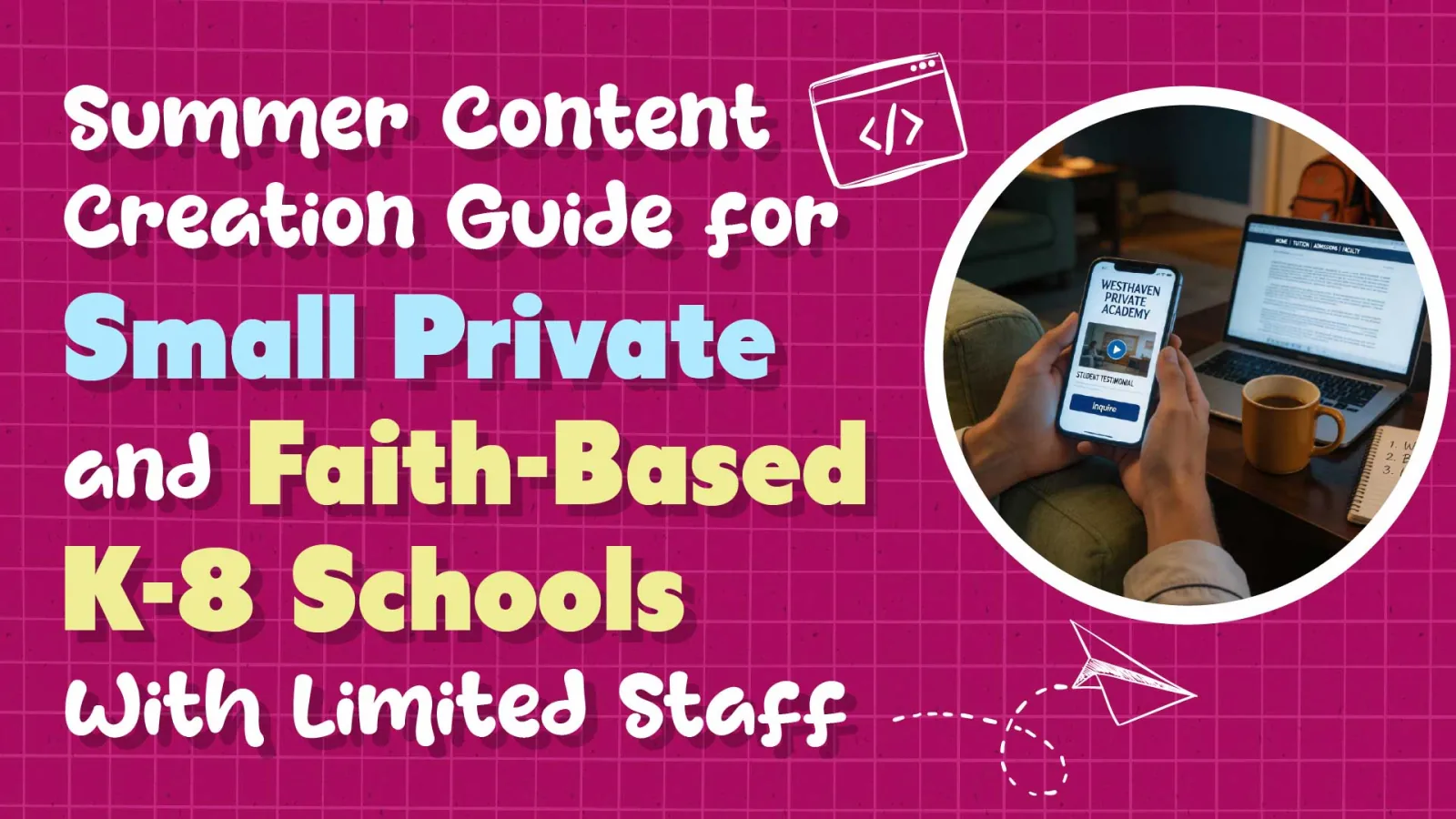
Summer is quiet on campus and loud in most marketing calendars. At faith-based and independent schools where the principal handles content alongside everything else, the choice each summer is almost always the same: burn out trying to keep up week by week, or spend two focused weeks in June building a content bank that carries the school through the next six months. The second option is a real job. It is also the only sustainable one.
This guide is for a principal at a 150-200 student faith-based or independent K-8 school with a marketing budget of $25,000-$50,000 and no dedicated content team. It covers why summer is actually the best window to produce content, the types of posts that work for back-to-school and fall enrollment season, a framework for evergreen content that earns traffic year-round, how to batch video and photography alongside writing, how to use AI tools without losing the school's voice, a 12-week editorial calendar template, the SEO priorities that matter for school content, and the mistakes that quietly sabotage most school content programs.
Written By: Adam Bennett | May 07, 2026
Adam is the president and founder of Cube Creative Design and specializes in private school marketing. Since starting the business in 2005, he has created individual relationships with clients in Western North Carolina and across the United States. He places great value on the needs, expectations, and goals of the client.
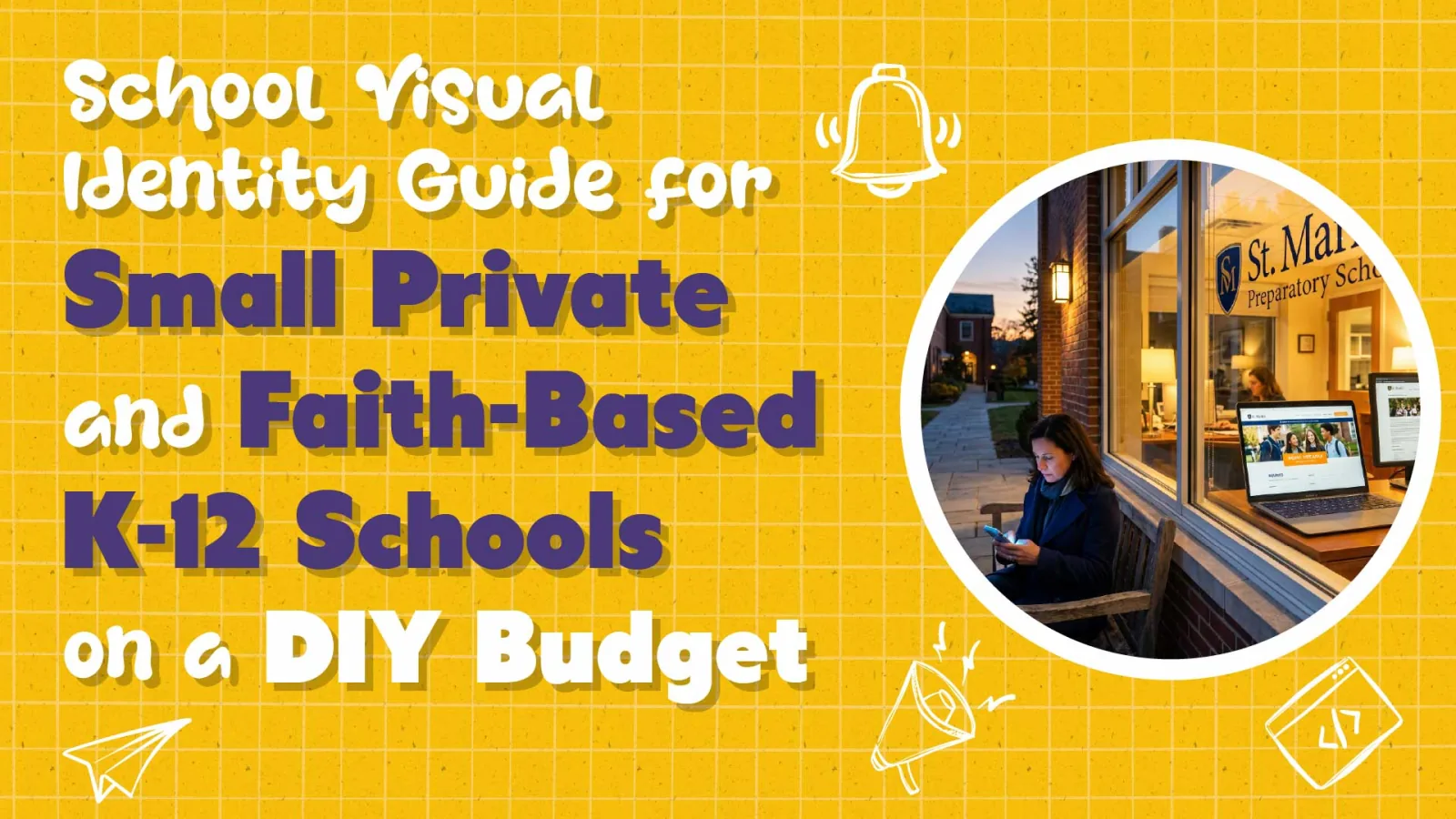
If you run a small faith-based or private school and your marketing budget is somewhere south of $15,000 a year, most "visual identity" advice is written for somebody else. It assumes you have a brand manager, a design team, and a budget for a national agency engagement. You do not. You have a spare hour on Thursday after the faculty meeting, a Canva subscription somebody set up two years ago, and a logo file whose origin you have forgotten.
This guide is for the principal who is doing the marketing alongside everything else at a 150-250 student faith-based K-12 with tuition in the $3,000-$5,000 range and a marketing budget of $5,000-$15,000. It covers the essential components of a school visual identity, why visual consistency matters even more for small budget schools than big ones, the minimum viable brand system you can actually ship this summer, the DIY tools that close most of the design-skill gap, how to handle faith-based imagery, when it makes sense to hire a designer, and how to keep the identity consistent after the summer project ends.
Written By: Adam Bennett | May 07, 2026
Adam is the president and founder of Cube Creative Design and specializes in private school marketing. Since starting the business in 2005, he has created individual relationships with clients in Western North Carolina and across the United States. He places great value on the needs, expectations, and goals of the client.